A circular metal ring of radius of rotates about a vertical diameter with constant angular velocity. As shown in the figure, a small magnetic needle that can turn freely about a vertical axis sits in the middle of the ring.
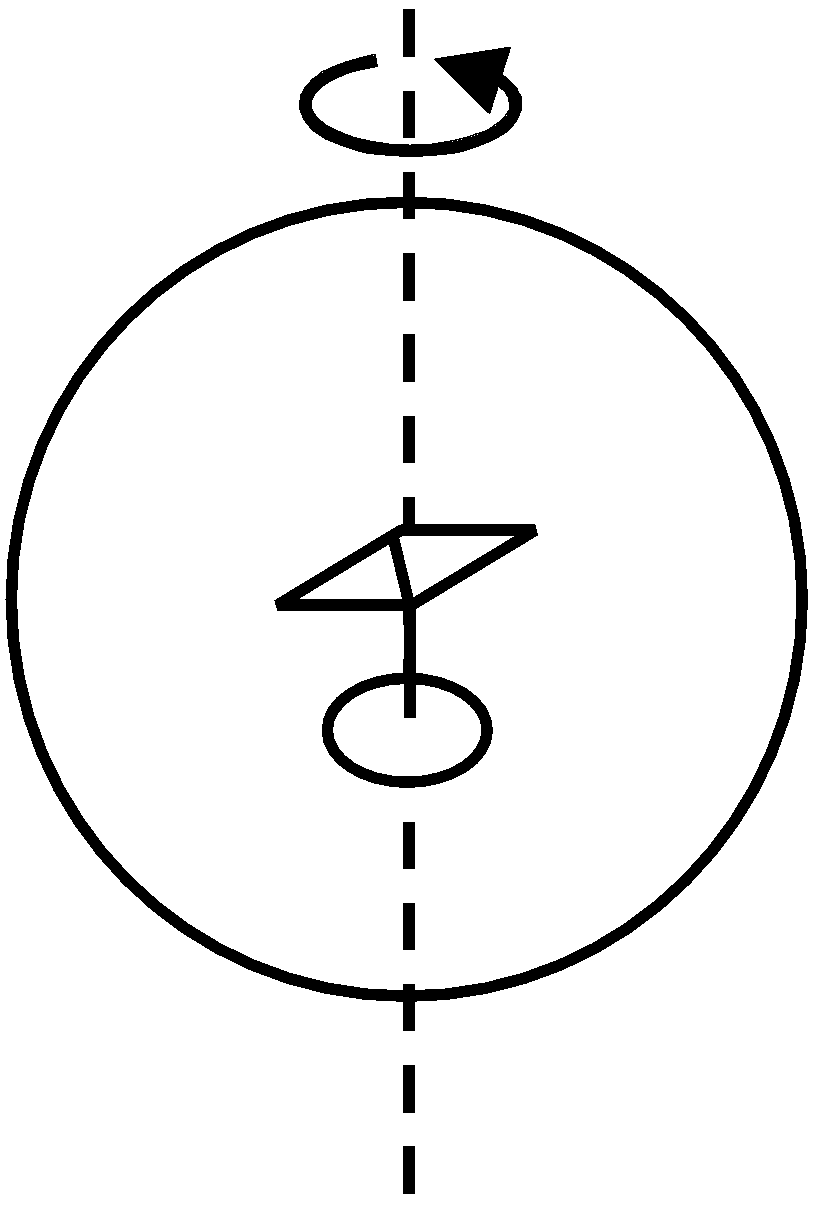
When the ring is stationary, the needle points in the direction of the horizontal component of the Earth’s magnetic field. However, when it rotates at the rate of ten turns per second, the magnet deviates by an average of α from this position. What is the electrical resistance R of the ring?
Text Solution
Verified by ExpertsCHECK THE SOLUTION.
Sol. We resolve the magnetic field of the Earth into its horizontal and vertical components. The vertical component induces no current in the ring, since its flux through the ring is always zero (angle between area vector and vertical magnetic field is 90º). Let the horizontal component of the magnetic field be  and the angular velocity of the ring be ω . The magnetic flux linked with the ring is
φ = π r 2 B cos ω t,
And the induced voltage is V = –(d φ /dt) = π r 2 B ω sin ω t. The current,
I =  =
=  sin ω t,
Flowing in the ring, induces a magnetic field at the centre of the ring of magnitude
B I = μ 0  = μ 0
= μ 0  sin ω t.
The direction of the magnetic field  is perpendicular to the plane of the ring and rotates with it. Resolve the vector
  into a component parallel to
  and a component perpendicular to it. The parallel component is proportional to cos ω t × sin ω t =
  sin 2 ω t, which average to zero over time. The perpendicular component can be written as
B ⊥ ⊥ = μ 0  sin 2 ω t = μ 0
  (1 – cos 2 ω t).
This expression consists of a term varying (relatively rapidly) with time and which, on average, is zero, and a constant term that causes the magnetic needle to deviate by α from its original (north-south) direction. Since the needle aligns itself with the direction of the (average) resultant field,
tan α =  = μ 0
= μ 0  .
.
The needle will make small oscillations about the above position, with an amplitude determined by the mechanical and magnetic characteristics of the needle and by the damping forces
Note that the angle of deviation of the magnetic needle does not depend on the magnitude of the Earth’s magnetic field, although its horizontal component is non-zero.
Prepare Smarter with CGP Edu
Get practice questions, solutions, and test series in one place.
Write a Review
Share your experience with this question and solution.
Commentary
Send your comment, doubt, correction, or feedback to admin.
Similar Questions
Explore conceptually related problems